
Creative approvals were a major bottleneck in the campaign delivery pipeline. Every submission required a human reviewer to manually check for policy violations, image quality issues, and landing page problems. The volume of submissions meant reviewers were spending the majority of their time on routine checks, leaving less time for the nuanced judgment calls that actually benefit from human expertise.
Routine issues that should have been caught before submission were regularly making it to human review, creating rework cycles and slowing turnaround times.
Rather than building a single AI check, the team designed a multi-layer review system. Each layer addresses a different category of potential issues: hard-coded policy checks parse each character and detect major issues deterministically, then an AI layer handles subjective judgment calls that require contextual understanding. Results from both layers are aggregated and logged.
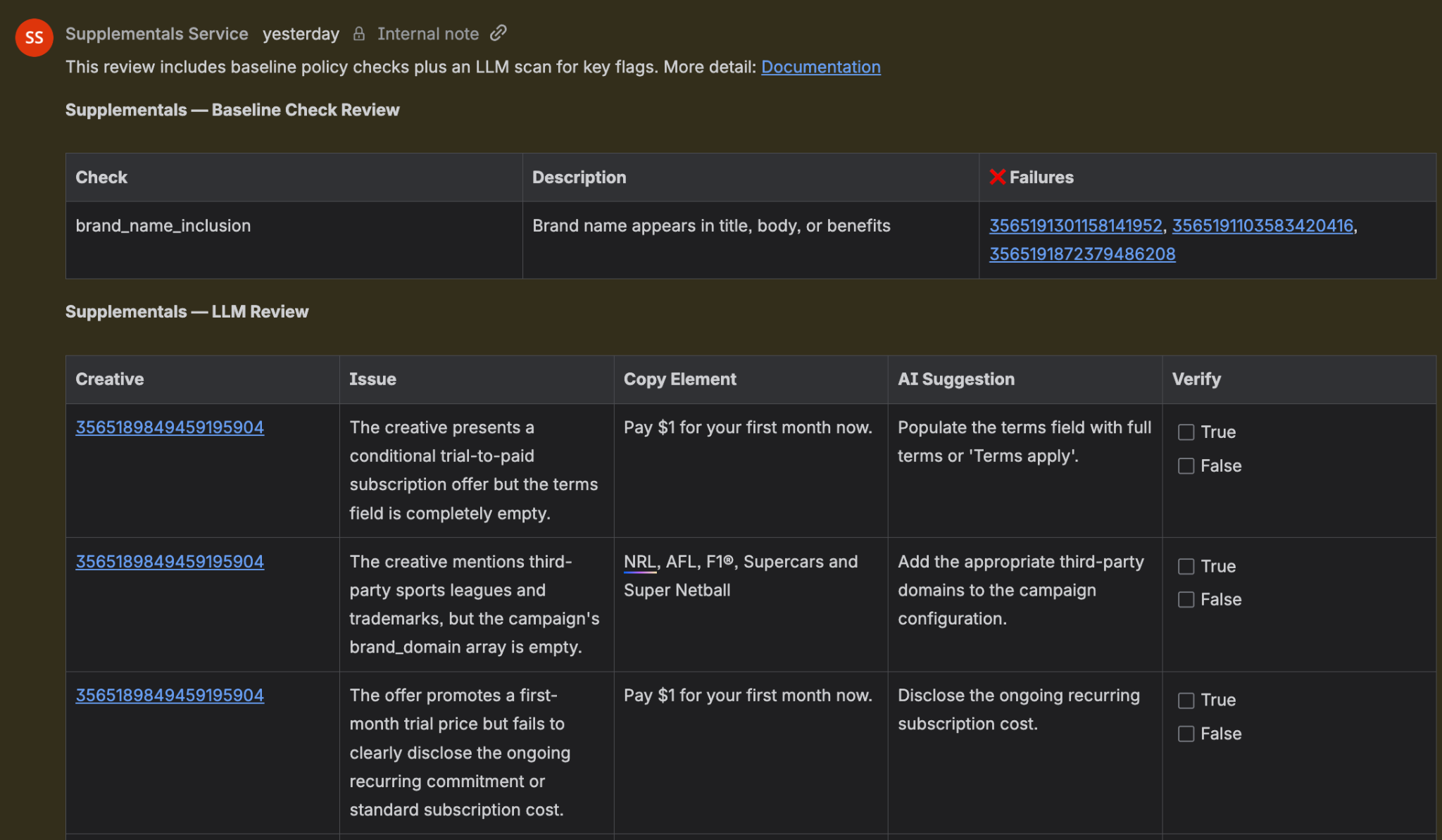
This is the strongest example of the team's layered AI approach. Humans still make the final call on every submission, but AI handles the mechanical screening across multiple dimensions. The system posts structured findings directly to the relevant ticket so reviewers can see exactly what was flagged and why.
The n8n automation workflow: data received from the internal platform flows through hard-coded pre-checks (empty fields, prohibited phrases, format validation, claims and dates), then into an AI layer for subjective review, before results are aggregated and logged.
The structured output posted to the ticket: a baseline check review flags deterministic issues, while the LLM review identifies subjective concerns with AI suggestions and a verify checkbox for the human reviewer.
The prompt above is a starting point, not a one-shot solution. The actual build required multiple iterations: refining instructions based on output, uploading reference documents for context, mapping the right tooling and integrations, and working through edge cases. Treat this as the brief that kicks off the conversation, not the conversation itself.
The multi-layer review system catches routine policy violations, image issues, and landing page problems before a human reviewer is involved. Reviewers now spend their time on the submissions that genuinely need human judgment rather than catching mechanical issues. The layered approach means each category of check can be improved independently, and new layers can be added as new categories of issues emerge.